


In sterile pharmaceutical manufacturing, sterilization is no longer simply a final support step. It is a critical process that directly affects patient safety, regulatory compliance, product quality, and production efficiency.
Recent developments in EU GMP Annex 1 and FDA expectations place greater emphasis on risk-based manufacturing, validated processes, contamination control, and complete process traceability. Pharmaceutical manufacturers therefore need sterilization systems that provide consistent performance while supporting efficient and flexible production.
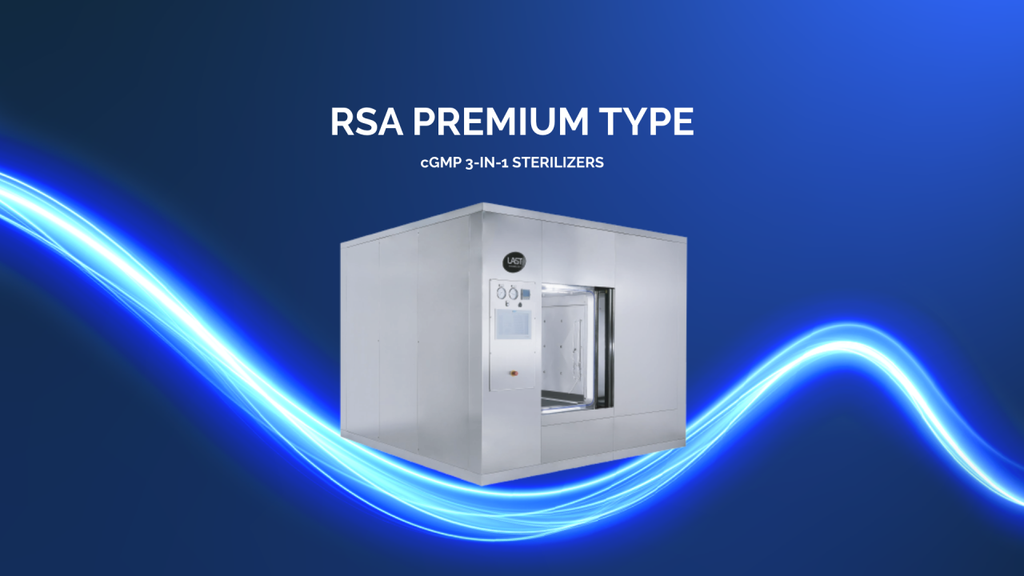
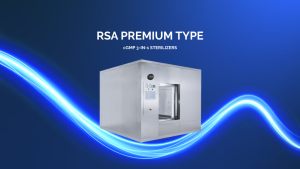
The RSA Premium 3-in-1 by LAST Technology is designed to meet these requirements. It combines sterilization, controlled drying, and cooling in one integrated system and supports three different sterilization technologies for a wide range of pharmaceutical products and materials.
WHAT IS RSA PREMIUM 3-IN-1 TECHNOLOGY?
The RSA Premium 3-in-1 is an advanced pharmaceutical sterilizer that integrates three essential production stages:
Sterilization → Controlled Drying → Controlled Cooling
Combining these processes in one system reduces manual handling, cleanroom movement, equipment requirements, and potential sources of process variability.
The system can also operate using three sterilization modes:
- Saturated steam for porous and non-porous loads.
- Air/steam mixture for pressure-sensitive containers and packaging.
- Superheated water for large-volume parenterals (LVP).
This flexibility allows pharmaceutical manufacturers to process different types of loads within one platform. It can be particularly valuable for multiproduct facilities, CDMOs, CMOs, and manufacturers with variable production volumes.
WHAT ARE THE CHALLENGES OF CGMP PHARMACEUTICAL STERILIZATION?
The objective of pharmaceutical sterilization is to achieve an appropriate Sterility Assurance Level (SAL) while maintaining product quality and container integrity.
However, achieving sterilization performance is only one part of a modern cGMP process. Pharmaceutical manufacturers must also consider:
- Process reproducibility
- Temperature and pressure uniformity
- Product and packaging integrity
- Contamination control
- Data integrity and traceability
- Validation and qualification requirements
- Manual handling and operator intervention
- Energy and water consumption
- Equipment maintenance and cleanroom space
A modern pharmaceutical sterilizer therefore needs to provide more than heat. It must deliver controlled, repeatable, validated, and traceable processes.
This is where combined sterilization technology can provide an important operational advantage.
RSA PREMIUM 3-IN-1: ONE PLATFORM, THREE STERILIZATION TECHNOLOGIES
The main advantage of the RSA Premium is its ability to combine multiple sterilization methods in one system.
1. SATURATED STEAM STERILIZATION
Saturated steam is suitable for a wide range of heat-resistant pharmaceutical loads, including:
- Stainless steel components
- Technical garments
- Stoppers
- Equipment parts
- Porous materials
- Other heat-stable components
The RSA Premium uses fractionated vacuum pulses to remove air and promote effective steam penetration.
During the cycle, automated process controls regulate steam injection and pressure. Condensate management helps maintain thermal uniformity, while the final deep-vacuum drying phase produces a dry load that is ready for subsequent handling or packaging.
2. AIR/STEAM MIXTURE STERILIZATION
Sensitive pharmaceutical packaging can present different challenges during sterilization.
Products such as pre-filled syringes (PFS), vials, bags, and polymer containers may require controlled pressure conditions to protect container integrity.
The RSA Premium uses an air/steam mixture to control the chamber environment and manage pressure differences during the cycle.
An integrated ventilation system mixes filtered air and steam, while the control system continuously monitors process parameters.
This approach helps reduce the risk of:
- Container deformation
- Leakage
- Packaging damage
- Pressure-related product failures
3. SUPERHEATED WATER STERILIZATION
Superheated water is particularly suitable for large-volume pharmaceutical products, including Large Volume Parenterals (LVPs).
In this configuration, pharmaceutical-grade water acts as the thermal transfer medium. High-flow water circulation supports efficient heat distribution throughout the load.
The system can be used for products such as large bottles and bags while supporting controlled heating and cooling.
Heat exchangers separate the service fluid from the pharmaceutical product, while controlled circulation helps achieve consistent thermal distribution.
TERMINAL STERILIZATION AND ASEPTIC PROCESSING
Sterilization technology plays an important role in pharmaceutical manufacturing, particularly where terminal sterilization is possible and appropriate.
The RSA Premium is designed as a combination sterilizer rather than a conventional steam-only autoclave. Its ability to operate with saturated steam, air/steam mixtures, and superheated water provides flexibility for facilities handling different products and packaging formats.
This is especially relevant for manufacturing environments where glass, stainless steel, polymers, liquid products, and other materials must be processed using different sterilization conditions.
It is important to distinguish this application from dry heat sterilization and depyrogenation. A DHS (Dry Heat Sterilizer), for example, is primarily associated with dry-heat processes and depyrogenation. The RSA Premium focuses on flexible terminal sterilization using multiple wet-heat technologies.
THE DUAL INTEGRATION BEHIND THE 3-IN-1 CONCEPT
The RSA Premium combines two forms of integration.
OPERATIONAL INTEGRATION
The system automates the complete sequence:
Sterilization → Drying → Cooling
This reduces the need to transfer hot or wet loads between different pieces of equipment.
As a result, manufacturers can reduce manual intervention and potentially simplify material flows inside controlled environments.
PROCESS INTEGRATION
The second level of integration is the ability to select the sterilization method according to the product.
| Sterilization mode | Typical application |
|---|---|
| Saturated steam | Solids, porous loads and heat-resistant components |
| Air/steam mixture | PFS, vials, bags and pressure-sensitive packaging |
| Superheated water | Large-volume parenterals and liquid products |
This makes the system particularly attractive for multiproduct pharmaceutical manufacturing.
COMBINED STERILIZER VS. DEDICATED AUTOCLAVES
A 3-in-1 sterilizer is not automatically the best solution for every pharmaceutical facility.
The right choice depends on production volume, product diversity, available cleanroom space, validation strategy, and capital investment.
A combined sterilizer can be particularly advantageous when a facility needs to process different types of loads without installing several dedicated machines.
For example, a 3-in-1 system can be attractive for:
- Multiproduct pharmaceutical facilities
- CDMOs and CMOs
- Variable-batch production
- Facilities with limited cleanroom space
- Manufacturers requiring flexible equipment utilization
By contrast, a dedicated sterilization line may remain the better option for single-product, very-high-volume manufacturing, where maximum throughput is the primary objective.
The decision should therefore be based on the facility’s actual load mix, production volume, space requirements, validation strategy, and total cost of ownership.
BENEFITS OF RSA PREMIUM 3-IN-1 STERILIZATION
Integrating three sterilization technologies into one platform can provide several operational benefits.
REDUCED EQUIPMENT FOOTPRINT
One integrated platform can reduce the need for multiple sterilization machines and associated cleanroom infrastructure.
This can help manufacturers make more efficient use of valuable controlled production space.
REDUCED MANUAL HANDLING
Automating sterilization, drying, and cooling within the same system reduces transfers between equipment.
Fewer manual interventions can also help reduce opportunities for human error and contamination.
SIMPLIFIED MAINTENANCE
A unified control architecture, including HMI/SCADA, can simplify equipment management and operator interaction.
A modular design can also support maintenance activities and help reduce equipment downtime.
LOWER TOTAL COST OF OWNERSHIP
When appropriate for the production profile, combining several processes into one system can reduce the number of machines, utilities, maintenance activities, and associated infrastructure required.
SUSTAINABILITY
Optimized sterilization cycles and heat-recovery solutions can help reduce energy and water consumption.
This supports the growing focus on sustainable pharmaceutical manufacturing and Green Pharma initiatives.
cGMP COMPLIANCE AND VALIDATION READINESS
For pharmaceutical manufacturers, equipment design must support qualification, validation, data integrity, and regulatory inspections.
The RSA Premium incorporates features designed to support these requirements, including:
- Hygienic design: Internal surfaces with roughness of Ra ≤ 0.35 µm and chemically passivated surfaces.
- ALCOA+ data integrity: Batch data can be recorded in a traceable and controlled format.
- Validation access: Dedicated Tri-Clamp nozzles facilitate the installation of validation probes.
- Effective condensate drainage: The chamber floor is designed to support complete drainage and minimize areas where microbial contamination could accumulate.
- Construction materials: AISI 316L stainless steel for process-fluid contact surfaces and AISI 304 for external structures.
- Process instrumentation: Pressure sensors, level sensors, pressure transducers, temperature probes, and safety valves support process monitoring and control.
- Operating conditions: The system is designed for temperatures from -10°C to +143°C and pressures from -1 to +3 bar, with a sterilization operating range of 60–134°C.
These design features can support pharmaceutical manufacturers during equipment qualification and ongoing process validation.
WHY CHOOSE A 3-IN-1 PHARMACEUTICAL STERILIZER?
The key benefit of the RSA Premium 3-in-1 is flexibility.
Instead of designing a facility around one sterilization method, manufacturers can select the appropriate process according to the characteristics of the load.
Saturated steam can be used for solid and porous materials. Air/steam mixture cycles can protect sensitive packaging. Superheated water can support the sterilization of large-volume liquid products.
At the same time, sterilization, drying, and cooling can be integrated into a single production workflow.
For facilities managing multiple products and changing production requirements, this flexibility can improve equipment utilization while reducing the need for multiple dedicated machines.
Modern pharmaceutical manufacturing requires sterilization systems that combine process control, flexibility, validation readiness, and operational efficiency.
The RSA Premium 3-in-1 by LAST Technology brings three sterilization technologies into one integrated platform:
Saturated steam + Air/Steam mixture + Superheated water
By combining these technologies with controlled drying and cooling, the system provides a flexible solution for different pharmaceutical loads and production requirements.
For multiproduct facilities, CDMOs, CMOs, and variable-batch manufacturers, a 3-in-1 sterilizer can offer significant advantages in equipment utilization, cleanroom space, process flexibility, and total cost of ownership.
For very-high-volume single-product manufacturing, dedicated sterilization systems may still provide the most efficient solution.
Ultimately, the best sterilization technology depends on the facility’s product portfolio, load characteristics, production volume, validation requirements, available space, and long-term investment strategy.
RSA Premium 3-in-1 demonstrates how integrated pharmaceutical sterilization technology can help manufacturers build more flexible, efficient, and controlled cGMP production processes.


 English
  Vietnamese